At the Races: Waiting on SCOTUS

Welcome to At the Races! Each week we bring you news and analysis from the CQ Roll Call campaign team. Know someone who’d like to get this newsletter? They can subscribe here.
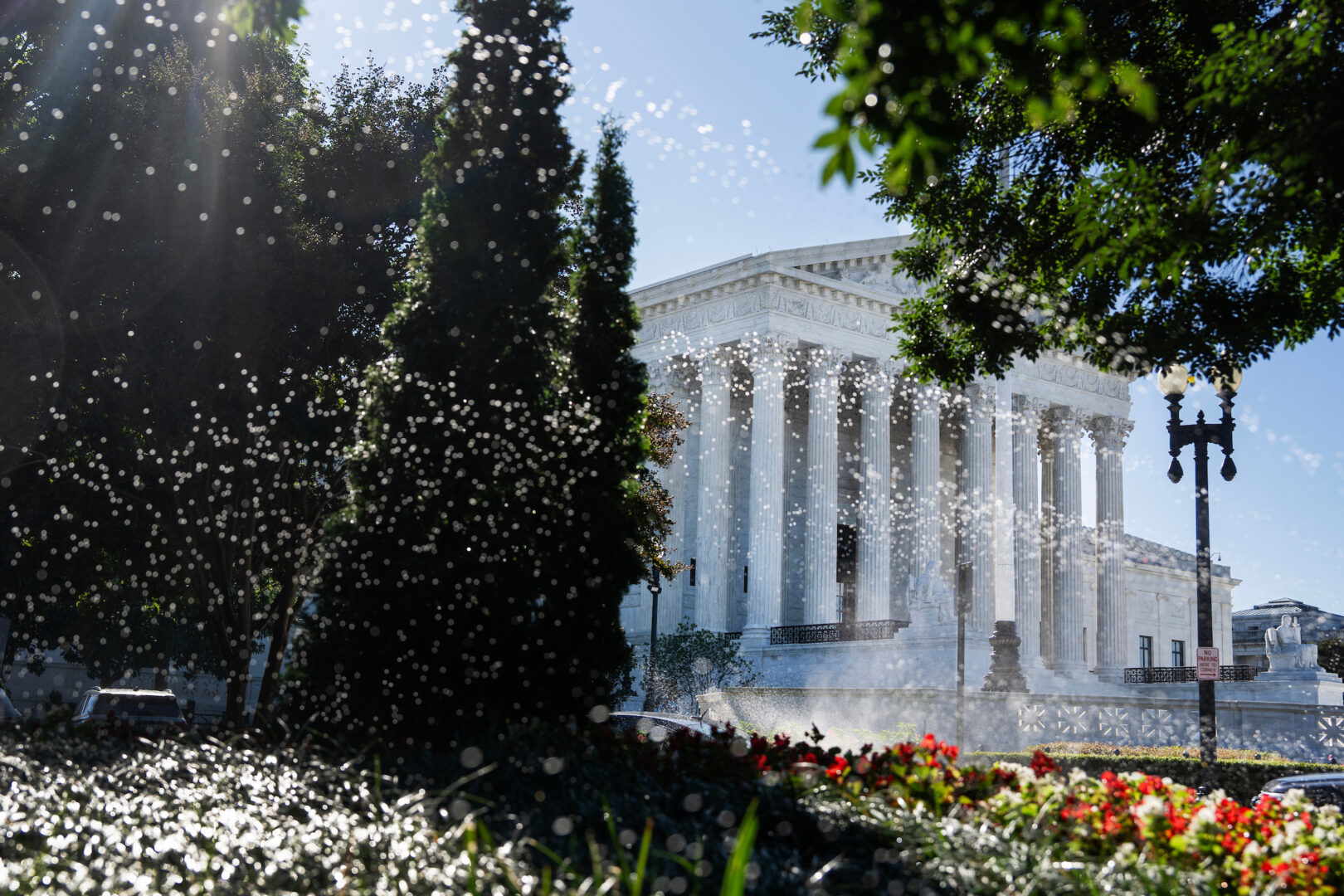
The end of June brings thunderstorms, fireworks and Supreme Court rulings.
And one still outstanding case could have major implications for how much political party committees can coordinate with candidates, potentially opening up a new front for political advertisements. The outcome of the case, NRSC v. FEC, could change how political parties coordinate with individual campaigns and could lessen the need for party committees to make independent expenditures on behalf of candidates.
The National Republican Senatorial Committee, JD Vance, then a Senate candidate from Ohio, and former Ohio Rep. Steve Chabot first brought the case, contending that the restrictions blocking party committees from spending alongside candidates violated the committees’ free speech rights to support their chosen candidates.
Our colleague Michael Macagnone reported after oral arguments in December that the justices “gave a mixed reception” to the case, which could mark the latest instance of the high court overturning campaign finance limits.
Under current law, expenditures coordinated between parties and campaigns are subject to spending limits. For most House races, that cap is set at $63,600, while the limits for Senate races vary by state, from as low as $127,000 in Alaska up to $3.9 million in California. If the Supreme Court rules with Republicans, candidates and parties would have more leeway to coordinate on ad spending, which could mean that party committees would benefit from lower ad rates available to candidates.
While Republicans have argued that the restrictions limit parties’ free speech rights, Democrats have warned that overturning the restrictions could lead to more influence from wealthy donors in campaigns.
The Supreme Court is expected to release additional opinions as early as Monday.
Starting gate
Battle on the Front Range: The race for the Democratic nomination in Colorado’s 8th District – arguably America’s swingiest seat – pits former state Rep. Shannon Bird, a political pragmatist with deep roots in the district, against state Rep. Manny Rutinel, the son of an immigrant single mother who has campaigned on a populist message. The winner of Tuesday’s primary will take on Republican freshman Rep. Gabe Evans in a race that could determine control of the House.
Primary night: Tuesday was a big night for New York City Mayor Zohran Mamdani, who saw a trio of House candidates endorsed by him all win their primaries. Two knocked off Democratic incumbents Dan Goldman and Adriano Espaillat. In other key New York races, state Assemblymember Micah Lasher is poised to succeed his former boss, Rep. Jerrold Nadler, and Army veteran Cait Conley will challenge GOP Rep. Mike Lawler in what’s expected to be a hotly contested House race this fall. Meanwhile, Maryland Rep. April McClain Delaney fought back a challenge from her predecessor, former Rep. David Trone, and two House Republicans from Utah, Reps. Blake D. Moore and Celeste Maloy, also overcame primary challenges.
Ranked choice complete: Maine State Auditor Matt Dunlap won the Democratic nomination for the battleground 2nd District, where Democrat Jared Golden is retiring. He triumphed under the state’s ranked choice voting process, defeating the DCCC-backed state Sen. Joe Baldacci in the final round. Dunlap will next face former Gov. Paul LePage, who was unopposed in the Republican primary.
Staffer to member: Colorado freshman Rep. Jeff Crank recalls an earlier stint on Capitol Hill, when he worked as an aide to Republican Joel Hefley. Crank now holds an altered version of the seat once represented by Hefley. Our colleague Jackie Wang has more.
ICYMI
Endorsements: The gun violence prevention group Brady PAC rolled out a series of endorsements of Democratic House hopefuls. The list includes Justin J. Pearson in Tennessee, Paige Cognetti in Pennsylvania, Christina Hines in Michigan, Sarah Trone Garriott in Iowa, Katy Padilla Stout in Texas and Hilda Solis in California. Maryland Sen. Chris Van Hollen has endorsed Abdul El-Sayed in Michigan’s Democratic Senate primary. In Minnesota, Rep. Angie Craig won the backing of Delaware Sen. Chris Coons and former Michigan Sen. Debbie Stabenow in her quest for the Democratic Senate nod, while rival Peggy Flanagan, the state’s lieutenant governor, secured the support of Rep. Betty McCollum. On the Republican side, the political arm of the conservative Americans for Prosperity is backing Alaska Sen. Dan Sullivan, who faces a tough challenge from Democratic former Rep. Mary Peltola.
Who goes first?: The political arm of the Congressional Hispanic Caucus is making the case for Nevada to hold the Democratic Party’s first presidential primary in 2028, pointing to the state’s high share of Latino voters. “Elevating a battleground state with the fifth highest share of Latinos to kick off the nominating process ensures our party puts forth a nominee who can succeed in a general election and sets us up to elect Democratic majorities to the House and Senate,” California Rep. Linda T. Sánchez, the chairwoman of BOLD PAC, said in a statement.
Dollar for dollar: The Congressional Leadership Fund, the primary super PAC of House Republicans, said it was adding $22 million to its fall ad reservations in Florida and Virginia. The announcement comes a week after the group’s Democratic counterpart, House Majority PAC, added reservations in the same markets.
Broadening the battleground: EMILY’s List Action announced a seven-figure digital ad and mail campaign targeting female voters in Colorado’s 5th District, Florida’s 13th and Ohio’s 10th. The spots criticize Republican incumbents over their support for Trump’s economic policies.
Ad watch: Former New York Rep. Chris Collins, who is now running for an open House seat in Florida, released his first campaign ad, which heavily features Trump and labels Collins “the original Trump conservative.” Meanwhile, the NRSC released a digital ad slamming Michigan’s El-Sayed as “too radical for Michigan.” El-Sayed is locked in a three-way Senate primary against Rep. Haley Stevens and state Sen. Mallory McMorrow. And Arizona Democrat JoAnna Mendoza, a retired Marine running for a battleground House seat, released her first ad, which spotlights veterans reflecting on their military service.
Nathan’s notes
Republicans should think twice before celebrating the primary losses of DCCC-backed Democratic House candidates, Roll Call elections analyst Nathan L. Gonzales of Inside Elections writes. More than a few upset primary winners, including a handful of Republicans, have ended up getting elected to Congress, Nathan points out.
What we’re reading
A deal to drop out? Robert F. Kennedy Jr. urged Libertarian candidates in Iowa to drop out of key races to help boost Republicans’ chances of maintaining control of the House, The Washington Post reported. “I can’t go into specifics because there’s legal prohibitions about that,” Kennedy told Rick Stewart, who is running in Iowa’s 2nd District, in a June 11 call, according to an audio recording obtained by the Post. “If it’s something that you want to talk about, you know, you and I can talk about specifics.”
Missing issue: Social Security is six years away from insolvency, the program’s trustees recently warned. But you wouldn’t know that from listening to most of the candidates running for House and Senate this year. The Washington Examiner looks at how the program’s pending crisis has been largely absent from the midterm campaign trail.
Corrupt elites: In midterm races across the nation, Democrats (and at least one Republican) are running ads criticizing the “Epstein Class,” a term that has become synonymous with entrenched corruption. The 19th tracked some of the races where candidates are campaigning against elites in both parties who traveled in the same circles as the late convicted sex offender.
Checking in from the middle: While Mamdani-backed candidates had a great night Tuesday, the results were more mixed for Democratic Gov. Kathy Hochul’s picks. City & State New York checked in with Hochul post-primary and found her “unbothered by the fact that socialist populism was favored over her flavor of traditionally moderate messaging.”
Adding it up: Who’s funding the midterms? The Washington Post provides a handy rundown of the megadonors who have poured more than $1.3 billion into the 2026 election.
The count: 23
That’s how many House incumbents first came to Congress by knocking off an incumbent from their own party: 13 Democrats and 10 Republicans.
One of the Democrats, California’s Ro Khanna, unseated eight-term Rep. Michael M. Honda in the 2016 general election after both Democrats had advanced out of the state’s top two primary. Additionally, two current senators – Oregon Democrat Ron Wyden and Kansas Republican Roger Marshall – also first came to Congress by way of unseating incumbents in House primaries.
Six House incumbents – three from each party – have lost reelection bids to nonincumbent challengers in their primaries this year, the most recent being New York City’s Espaillat and Goldman.
Heavily Democratic New York City is no stranger to candidates having to knock off incumbents to win a seat in Congress. The current House delegation includes four Democrats who took that route: Nydia M. Velázquez, Alexandria Ocasio-Cortez, George Latimer and Goldman himself. Goldman bested a 2022 primary field that included Rep. Mondaire Jones, who had moved to the district after his upstate seat was redrawn.
– By Roll Call’s Ryan Kelly
Key race: #CO01
Candidates: Since coming to Congress three decades ago, Democratic Rep. Diana DeGette has won reelection by comfortable margins. But this year, the 68-year-old incumbent faces a serious primary threat from two younger challengers: lawyer, doctoral student and democratic socialist Melat Kiros and University of Colorado Regent Wanda James.
Why it matters: The race reflects several themes coursing through Democratic politics this year, including the push for generational change, rifts over the war in Gaza and the rising political clout of the Democratic Socialists of America. The winner of Tuesday’s primary in the deep-blue district is expected to crest to victory in November.
Cash dash: DeGette raised $1.4 million through June 10, while Kiros brought in $663,000 since launching her campaign. James reported a haul of $291,000, which includes an $18,000 candidate loan.
Backers: DeGette has the support of her Democratic colleagues in the Colorado delegation, as well as the Congressional Progressive Caucus and several major labor unions. Kiros received a boost from Vermont Sen. Bernie Sanders and the political arm of the progressive group Justice Democrats. James was endorsed by the Collective PAC, which supports progressive Black candidates, and former senator and Interior Secretary Ken Salazar.
What they’re saying: The race has grown increasingly heated, with Kiros attacking DeGette as part of an ineffectual old guard propped up by billionaires and corporations. “Establishment Democrats have failed us,’’ Kiros declared in a recent ad. She backs “Medicare for All,” new taxes on individuals with a net worth above $50 million and “an immediate and unconditional arms embargo on Israel.” DeGette has emphasized her efforts to fight Trump and his “MAGA Republican” allies and protect access to abortion. She has also stressed her progressive bona fides, noting that she is a co-sponsor of legislation that would establish “Medicare for All” and is airing an ad featuring praise from New York Rep. Alexandria Ocasio-Cortez, who has not publicly endorsed a candidate in the race. An ad by Project 218, a PAC affiliated with the Democratic group American Bridge 21st Century, paints Kiros as a newcomer to Denver who brought an “extreme agenda” that includes defunding the police and abolishing the Senate. Both candidates have largely ignored James and focused on each other.
Terrain: The district covers Denver and the surrounding metropolitan area. Inside Elections rates the race Solid Democratic.
Wild card: Victories by left-flank candidates in three New York City congressional districts have bolstered progressive hopes that the “Mamdani effect” will reach the Rocky Mountains. “Today, the East Coast, next week the Mountain West,’’ the DSA posted on social media.
Coming up
Louisiana voters will pick their Senate nominees in primary runoffs this Saturday, while the month’s primary schedule concludes Tuesday when Colorado votes.
Photo finish
Subscribe now using this link so you don’t miss out on the best news and analysis from our team.